Can A Robot Palletizer Reduce Labor Costs And Boost Productivity?
Release time: 2026-01-27
Table of Contents
In view of the rising labor shortages and the push for “smart factory” integration, we’ll explore how robot palletizers work, their direct impact on your bottom line, and why 2026 is the tipping point for automation. Whether you are a plant manager, a CFO, or a packaging engineer, this analysis will help you calculate the true value of automating your end-of-line.
The End-of-Line Bottleneck: Why Manual Palletizing is Failing
For decades, the final step of the manufacturing process—stacking boxes onto a pallet—was a manual job. It was simple, low-skill, and flexible. But in today’s industrial landscape, manual palletizing has become a dangerous and expensive bottleneck.
As we move through 2026, manufacturers are facing a “perfect storm”: an aging workforce, skyrocketing injury claims, and consumer demands for faster delivery. The question is no longer if you should automate, but how soon you can implement a robot palletizer to stop the bleeding of capital.
This article breaks down the financial and operational reality of robotic palletizing, moving beyond the hype to look at hard numbers.
1. How Robot Palletizers Slash Labor Costs
When executives ask, “Can a robot palletizer reduce labor costs?” the short answer is yes. But the long answer is that it reduces costs in ways that don’t show up immediately on a payroll spreadsheet.
Direct Wage Displacement
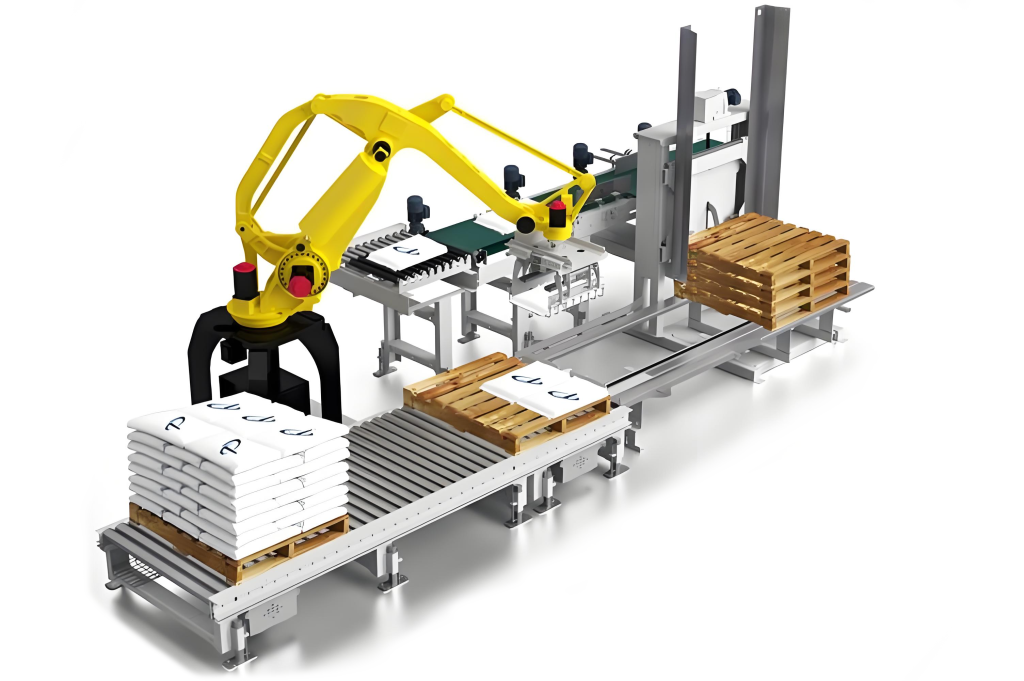
The most obvious saving is direct labor. A single robotic palletizing cell typically operates at the speed of 2 to 3 manual laborers.
- The Math: If you run a two-shift operation with two operators stacking boxes per shift, you are paying four salaries. A robot palletizer replaces the need for these operators to be stationed permanently at the line.
- The 2026 Reality: With the average fully burdened labor cost (wages + taxes + benefits) for a warehouse worker rising significantly, the ROI period for a robot has shrunk from 3 years to often less than 18 months.
Eliminating the “Hidden” Costs of Human Labor
The sticker price of an employee is just the tip of the iceberg. Robotic automation eliminates:
- turnover Costs: Recruiting and training new staff for high-turnover roles like palletizing is expensive. Robots don’t quit.
- Injury Claims: Palletizing is the #1 source of repetitive strain injuries (RSI) and lower back issues in packaging. One serious worker’s compensation claim can cost more than a down payment on a robot.
- Availability Gaps: Robots don’t take sick days, vacations, or breaks. You stop paying for “unproductive” time.
2. Boosting Productivity: The “Consistency Factor”
Labor savings are great, but productivity gains are where the profit margin truly expands. A human worker is fastest in the first hour of their shift. By hour seven, fatigue sets in, errors happen, and pace slows.
Throughput Stability
A intelligent robot palletizer acts as a metronome for your entire production line. It forces the upstream equipment to maintain a steady pace because the “bottleneck” at the end has been removed.
- Speed: Modern articulated robots and high-speed layer palletizers can handle anywhere from 10 to over 100 cases per minute (CPM), far outstripping human capability.
- 24/7 Capability: If you need to ramp up production for a seasonal spike, you don’t need to hire temporary staff. You simply run the robot longer.
Better Stack Quality = Less Damage
Productivity isn’t just about speed; it’s about yield. Manual pallets are often inconsistent—leaning stacks, large gaps, or poor wrapping.
- Load Stability: Robots use precise coordinates to place boxes. This results in perfectly square, stable pallets.
- Shipping Savings: A more stable pallet allows you to maximize truck space (cube utilization) and significantly reduces product damage during transit. If you are losing even 1% of your product to transit damage, a robot could pay for itself on that metric alone.
3. The 2026 Tech Shift: Cobots and AI
If you looked at robot palletizers five years ago and thought they were “too complex” or “too big,” it’s time to look again. The technology has evolved drastically.
The Rise of the “Cobot” Palletizer
Collaborative Robots (Cobots) have changed the game for small to medium-sized manufacturers (SMEs).
- Low Footprint: Unlike massive industrial cages, cobots can work safely alongside humans without safety fencing.
- Flexibility: They are easier to reprogram. If you change your box size next month, you don’t need an expensive engineer to rewrite code; you can often “teach” the cobot the new pattern in minutes.
AI and Vision Systems
In 2026, AI-driven vision systems are standard. Old robots needed boxes to be in the exact same spot every time. New robots with 3D vision can “see” a box coming down a conveyor slightly askew and adjust their grip instantly. This reduces jams and downtime significantly.
ROI Calculation: A Practical Example
To help you visualize the savings, let’s look at a hypothetical scenario for a mid-sized food manufacturer.
Current State (Manual):
- 2 Shifts/Day, 5 Days/Week.
- 2 Operators per shift (4 total).
- Fully Burdened Cost: $50,000/year per operator.
- Total Annual Cost: $200,000.
Future State (Robotic):
- Total System Cost (Robot, Conveyors, Safety, Install): $250,000 (one-time).
- Annual Maintenance/Energy: $10,000.
- Operator Cost: $0 (Line operators redeployed to Quality Control).
The Result:
- Year 1 Savings: -$60,000 (Investment year).
- Year 2 Savings: +$190,000.
- Payback Period: ~1.3 Years.
Note: This does not even include savings from reduced injuries or increased throughput.
FAQ: Common Questions About Robot Palletizers
Q: Will a robot palletizer fit in my small facility?
A: Yes. Modern “fenceless” Cobot palletizers have a footprint as small as a standard pallet. Vertical integration (stacking upwards) also saves floor space compared to manual sorting areas.
Q: Is it difficult to change stacking patterns?
A: Not anymore. Most modern Human-Machine Interfaces (HMIs) allow operators to drag-and-drop box dimensions to create new patterns without writing a single line of code.
Q: What happens if the robot breaks down?
A: Reliability for industrial robots is incredibly high (often 99.9% uptime). However, 2026 models often come with “Predictive Maintenance” features that alert you to wear and tear before a breakdown occurs.
The Verdict: Is It Time to Automate?
Can a robot palletizer reduce labor costs and boost productivity? Absolutely.
If you are producing fewer than 2-3 pallets per hour, manual labor might still be cost-effective. However, if your production exceeds that, or if you are running multiple shifts, the ROI is undeniable.
In 2026, automating your palletizing process is not just about cutting costs—it’s about future-proofing your business against labor volatility and securing a competitive advantage in speed and quality.